
Richard L. Dowell, Korean War
February 5, 1951, Central Corridor South Korea, Age 18
By Jim Watkins
Brown County Historical Society
The basic accounting of Brown County’s contribution to our nation’s service in the Korean War as listed on the Courthouse Memorial is: Served, 191, Killed, 7.
Richard L. Dowell was one of those seven.
Richard, “Dickie,” to family and friends, had enlisted in the Army in June of 1949 as was reported in the June 9th edition of The Democrat. It was a time of peace. World War II was in the rear-view mirror and the abundant resources that had built the “Arsenal of Democracy” were now responsible for new cars and modern appliances as well as many other consumer products. The fear of a post-war depression had not come to pass. Peacetime was wonderful.
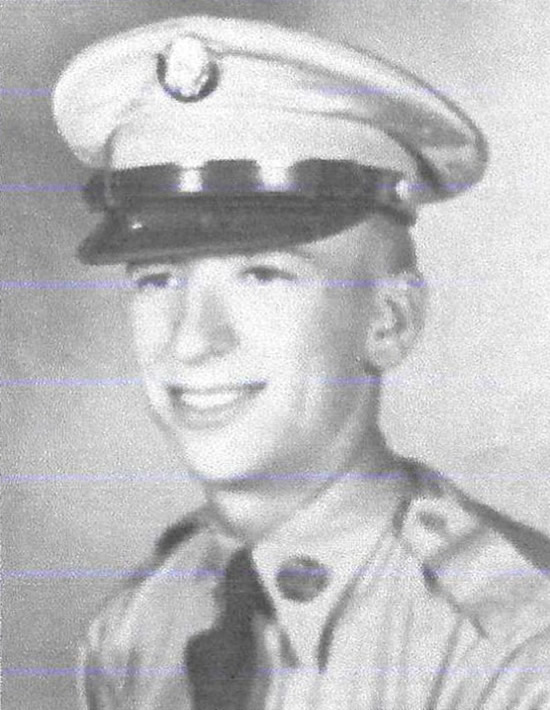
For Richard, he had finished Basic Training at nearby Ft. Knox and in early 1950 and according to The Democrat, had completed an eight-week course in meat cutting. Richard was no doubt thinking the rest of his enlistment would be in helping prepare meals for his fellow Gls.
That all changed on June 25, 1950.
Halfway around the world the communist North Korea army had crossed the border and invaded South Korea completely surprising the South Korean forces. This would be the first test for the newly created United Nations. The UN Security Council immediately met and passed resolutions to deal with the situation. Twenty-Two nations rallied to the call committing forces and/or medical help.
Witn the assistemee of their Soviet tanks the North Koreans swept southward until the South Korean, US, and other United Nations forces were able to make a stand in the southeast corner of the Korean peninsula by early August.
This 140-mile-long rectangle which included the vital port city of Pusan became known as the Pusan Perimeter and to quote David Halberstam from his 2007 Korean War history, The Coldest Winter, “the Pusan Perimeter battlefield was turning out to be one of the bloodiest of this or any other war fought by Americans. It would rank right up there with the worst of the Civil War battles and some of the terrible island-hopping campaigns in the Pacific.”
And this is where Richard Dowell found himself. No longer clutching a meat cleaver but a Browning Automatic Rifle, a BAR! The BAR weapon weighed just over 19 pounds loaded. It could be used to fire a single shot but more often was used as a semiautomatic able to fire several hundred rounds a minute. Capable of shooting large amounts of ammunition meant the soldier had to have a partner to carry the ammo required.
Richard was assigned to the 27th Infantry Regiment, the Wolfhounds, an amazing unit. They acted as a kind of “fire brigade.” Using the small but valuable rail system they were sped to a part of the perimeter where the North Koreans were trying to penetrate, and the Wolfhounds would plug the gap.
Because BAR gunners were so important to their units, they were frequent targets for the enemy. On September 4th, Richard was wounded. l:fe was evacuated to Japan, where he recovered from his wounds. While Richard was taken care of in Japan the war underwent a monumental change.
General MacArthur, leading a vast United Nations invasion force raced up the western coast of the peninsula and invaded at Inchon just west of the capital Seoul and close to the prescribed border, the 38th parallel.
This sent the North Korean forces fleeing from the Pusan Perimeter region north t0 deal with the UN counterattack. The now well equipped and enlarged UN forces re-captured Seoul and pushed northward across the 3gth parallel capturing the North Korean capital, Pyongyang. The northward offensive continued well into October approaching the Yalu River, the border between Korea and China.
At this point the war took another historic turn. The Chinese, fearing invasion sent massive forces of “volunteers” across the river. The usually fierce Korean winter was settling in and the UN forces were forced to retreat as the waves of Chinese streamed south.
By this time Richard had rejoined his Wolfhounds unit. A short letter he sent to his brother Charlie (Chuck) in Alaska pretty much describes the situation.
December 11, 1950
Hi Chuck,
Well, how is everything in Alaska? Better than things are here in Korea, I hope. Well, I am in Kaesong now just across the 38th parallel. We were up by the Yalu River and got our ass run back across the 38th. ‘There are just a few North Koreans left right now. It was the Chinese that ran our ass back.
I am all tired out from carrying the BAR and ammo belt. My ammo carrier got killed so now I have to carry both until they get me a new guy.
I wrote Mom yesterday, but I had not written in weeks. I just have not had time.
Love, Dick
The war pushed back down to the 3gth parallel region during the winter and the fighting would continue in this central corridor region for months to come. According to the Chaplain’s letter from headquarters, it was in this area on February 5, 1951, while trying to secure high ground with his platoon that Richard was struck by enemy mortar fire. He was evacuated by helicopter to the nearest MASH unit where he died of his wounds. The Dowell family was notified by telegram and The Democrat reported Richard’s passing in the February 15th edition. It was a few days later that Richard’s parents received the condolence letter signed by Gen. Douglas MacArthur.
Richard, known as Dick and Dickie, was the son of Marvin and Jennie Dowell of Nashville. His body was returned to Nashville that September, and he was buried at Green lawn Cemetery.
Local resident and Brown County l:listorical Society member, Brenda Hale Kelley, was Richard’s niece. I want to thank Brenda and her husband Rick for all the hard work and research they provided for this article. Copies of many of the items related to Richard’s story collected by Brenda and Rick can be viewed in a folder at the Veterans Display at the History Center.